Zati for medical-billing service firms
Give every recurring RCM task a named owner and a reviewable output
Zati gives outsourced medical-billing firms a workspace where AI workers hold defined responsibilities. You assign the work, set the inputs, inspect what comes back, and keep the decisions that require a billing professional. Start with one recurring responsibility, then build the team around the work that follows it.
Start with the work that keeps coming back
A denial queue that needs triage. An onboarding check that stalls on a missing intake item. A client reporting draft that has to be rebuilt every month. Each of these recurs, and each has an output your staff could actually use.
Pick one. Define what a useful result looks like before assigning anything, so the team has a destination rather than a task list.
Know exactly what comes back to you
Take a weekly denial issue queue, prepared from a deidentified denial-category and age-band export plus the public payer policies you supply.
- A research worker's assignment: assemble the denial categories, age bands and policy passages that apply, keeping the payer source and its date attached to every entry.
- A drafting worker's assignment: turn those inputs into issue-queue rows — category, age band, policy reference, the open question, and a proposed owner from your team.
- A reviewing worker's assignment: check each row against your brief, flag any claim that lacks a source, and mark entries where the correct outcome is no action this week.
- Your decision: accept, re-scope, or escalate each item to the named person who carries it.
The handoff is explicit: research hands to drafting, drafting hands to review, review hands to you. Each step has a named owner, so the next step is never left to assumption.
Keep the source visible
A category-level pattern is a prompt for review, not a conclusion about an account. The policy text and its date stay attached so a reviewer can see what the entry was drawn from. Where the supplied information cannot support a conclusion, the worker asks for the missing prerequisite instead of producing a confident-sounding line.
Make the decisions explicit
Decide what needs review and who makes the call. For denial work, that usually means the interpretation of a pattern and any payer-facing commitment stay with your billing staff. The team prepares, checks and flags; your people approve.
Your practice-management and billing systems remain the authoritative record. Approved exports provide the starting context, and any further access depends on the connections and permissions you authorize. You decide whether a given export is suitable to share and whether a proposed reading is sound.
See the team behind the result
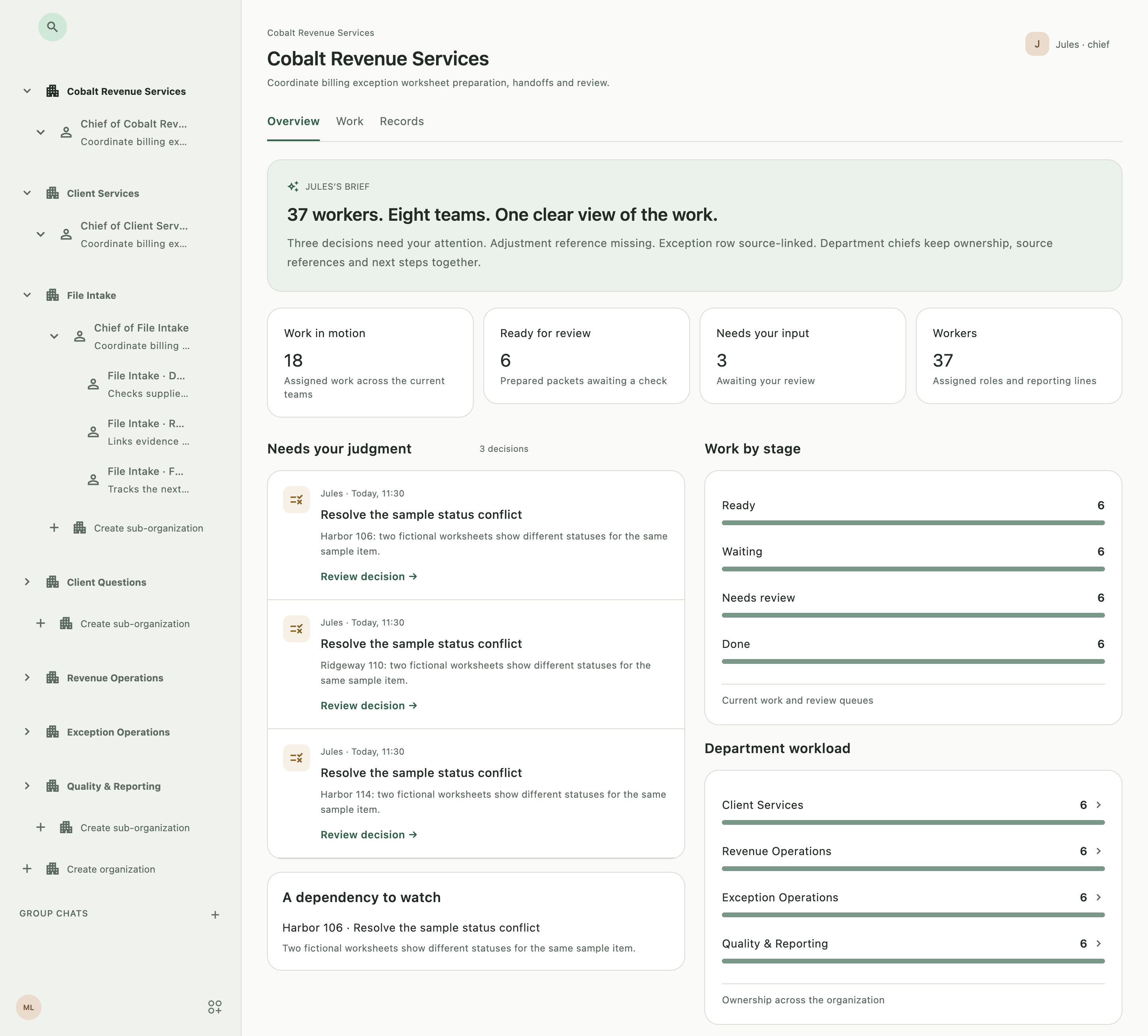
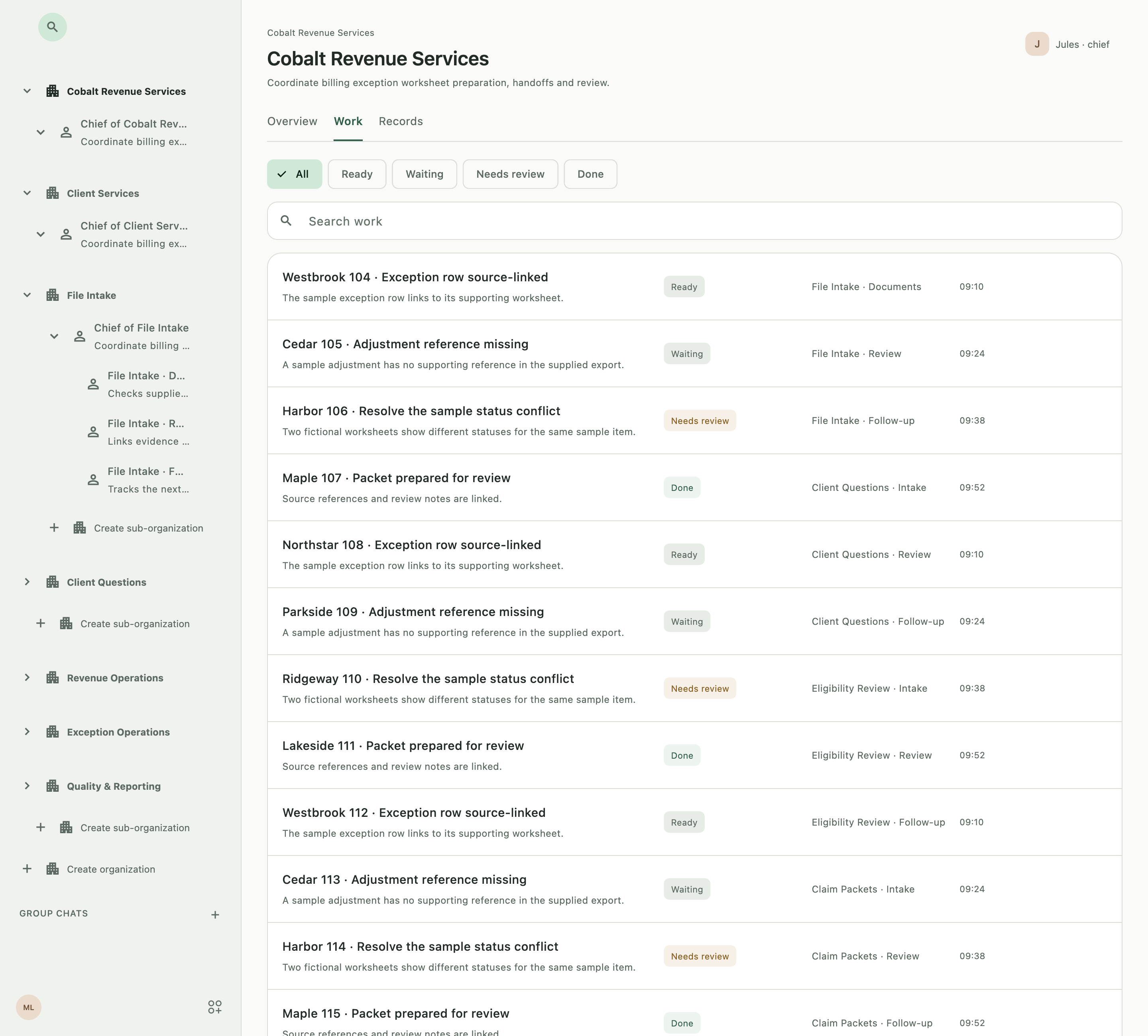
Keep workers, conversations, tasks and files in one organizational workspace. Give workers names, instructions and reporting relationships that match how your firm already works — a coordinator who owns review handoffs, specialists who own a narrow responsibility, and an accountable person who accepts each output.
Organizations, teams and workers in one workspace. Open the image for a full-size view.
Assigned work, review queues and next steps. Open the image for a full-size view.
Build around the work you have already proven
Once the denial queue is running, adjacent responsibilities become easier to define: client onboarding checks against your intake checklist, or a client reporting draft that separates established outcomes from unresolved questions. Each one is a new assignment with its own inputs, output and reviewer — not a new project.
Questions before you start
Do I need a large AI organization?
No. Start with the smallest team that makes one responsibility clear. Add roles when the work gives you a reason.
Will it work with the systems we already use?
Bring your current tools and workflow to the call. We will assess what connections, access and outputs your setup requires.
What should I bring to the discovery call?
One recurring responsibility, a sample of its inputs, and the result your staff wants. We can map the worker roles, review steps and handoffs around that work.
Choose the first responsibility to hand over
Bring the queue, the checklist or the draft that keeps rebuilding itself. We will work out the team around it.